Endowed progress makes a goal feel started.
Nunes and Drèze document the endowed progress effect: people given artificial advancement toward a goal are more likely to finish. Their well-known car-wash field study compared an 8-stamp card with a 10-stamp card that already had 2 stamps. The underlying work was the same, but the "started" version produced higher completion.
The lesson for local loyalty is not to manipulate customers. It is to reduce the psychological distance between "I joined" and "I can actually earn this." A welcome reward, first tap credit, or visible starting point can make the path feel active.
Goal-gradient effects pull customers toward completion.
Kivetz, Urminsky, and Zheng resurrected the goal-gradient idea for consumer rewards. Across field and experimental settings, participants accelerated effort as they approached a reward. In a cafe reward program, purchase frequency increased as customers got closer to earning the free coffee.
This matters for card and chip design. A customer who cannot tell where they stand has no goal gradient to feel. A customer who sees "one more visit unlocks the next perk" has a clearer reason to return.
Reachable beats vague.
Many loyalty programs fail because they make the reward feel distant or abstract. A large point balance can look impressive to the business and meaningless to the guest. The research favors progress that is concrete, legible, and close enough to matter.
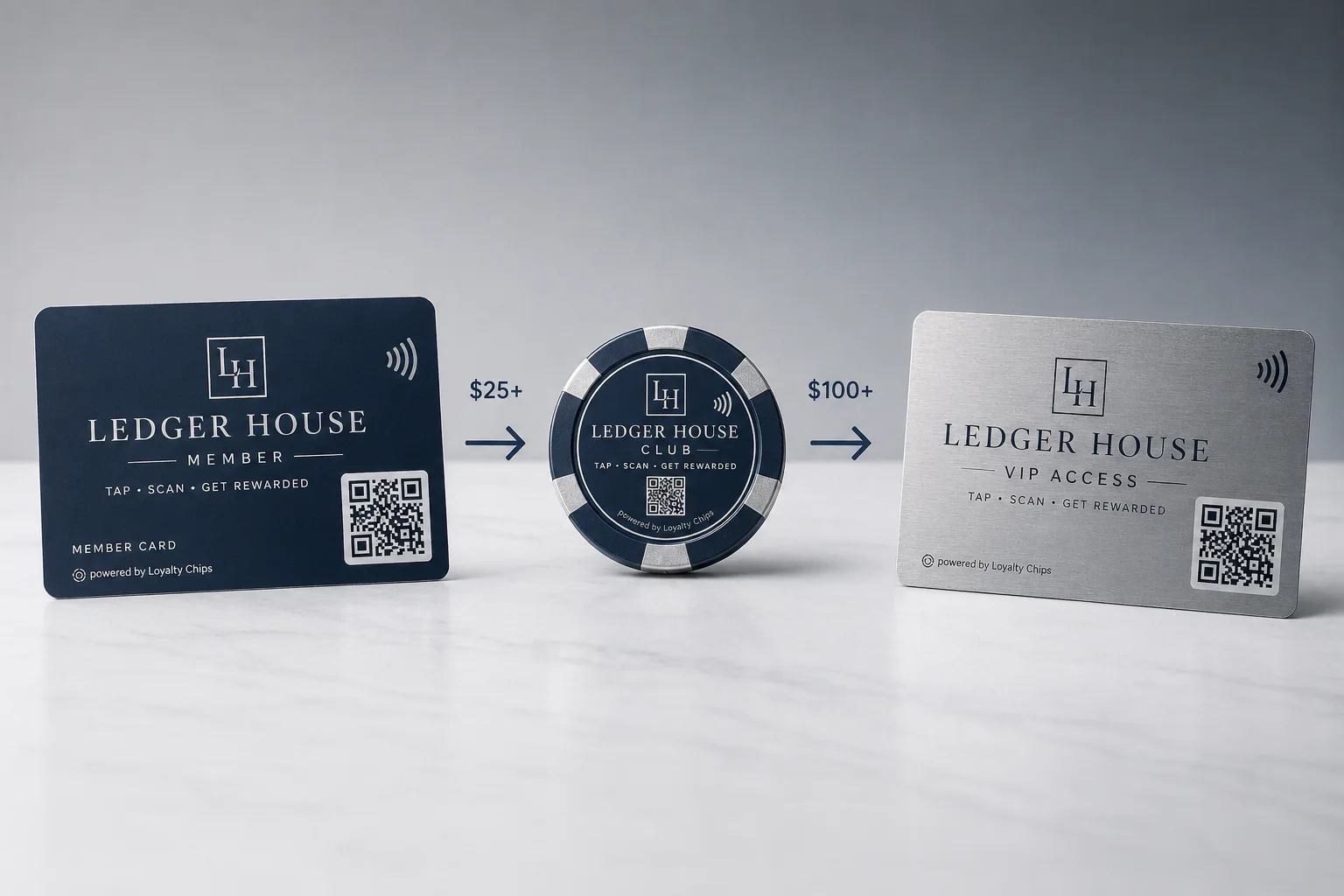
Loyalty Chips can support that with a simple flow: tap or scan, claim the current reward, capture the customer, and send the next offer with a specific reason to come back. The physical token keeps the program visible; the reward design keeps the next action reachable.
Design rule
Do not make customers do math. Show progress in plain language, keep the first reward close, and use every claim as the beginning of the next return path.
Sources
- Nunes and Drèze, "The Endowed Progress Effect: How Artificial Advancement Increases Effort," Journal of Consumer Research, 2006.
- Kivetz, Urminsky, and Zheng, "The Goal-Gradient Hypothesis Resurrected," Journal of Marketing Research, 2006.
- Yuping Liu, "The Long-Term Impact of Loyalty Programs on Consumer Purchase Behavior and Loyalty," Journal of Marketing, 2007.